• Skip to main content

College Hill Pilates and Physical Therapy LLC

Pilates Classes in Cincinnati

(513) 445-WELL (9355)
  • Home
  • Physical Therapy
    • Telehealth PT
  • Pilates
    • Pilates Mat Classes
    • Virtual Pilates Classes
  • Strength Training
  • Yoga
  • Tai Chi
  • Blog
  • Schedule

Proprioception

Feb 01 2022

Experiencing a Catastrophic Shoulder Injury from a Physical Therapist’s Perspective, One Year Later

I haven’t posted an update about my shoulder rehab process since last April, which is when I returned fully back to work. Not really a coincidence!

As of today it has been one year since my surgery to repair my torn labrum and Hill-Sachs lesion. For anyone just now catching this blog, I dislocated my shoulder when I tripped on a sidewalk crack and fell while jogging early in the morning January 14, 2021. I have been working very hard all year to rehab my shoulder. I would say it’s about 95% recovered at this point. I’m hopeful that there is still some improvement to be seen.

It has been a challenge to regain the mobility and rebuild the strength at the same time. I’m happy to report that my range of motion is nearly 100%. Functional reach behind my back is still a little limited but good enough to fasten a bra behind my back or loop my belt around the back of my waist. My strength is also mostly back to normal. I am able to do all of my work activities, including manual therapy, that I would normally do. I don’t notice many functional limitations at home either and was even able to return to playing tennis with my family this summer.

The big issue is still that pesky scapulohumeral rhythm, especially when I reach forward and up overhead.

https://www.collegehillpilatespt.com/wp-content/uploads/2022/02/Shoulder-flexion-and-scaption.mp4

You can see that my scapula still wings a little bit as I raise my arms up and down. This is caused by the continued limited range of motion of the actual ball-and-socket joint of my shoulder. So more of the motion has to come from the shoulder blade moving excessively. This causes pinching of the soft tissue structures in the subacromial space because the humeral head does not glide downward as it rolls upward. As a result, these impinged structures cause pain. This pain is the biggest problem that is yet to resolve. I notice it the most at night because I still wake up several times a night in pain. If I spend too long in any sleeping position, it becomes painful and wakes me up. Happily, I am able to fall back asleep once I shift positions are rearrange myself. But my ultimate goal is to not wake up at night due to pain.
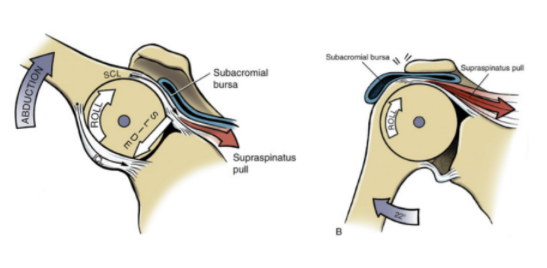
Glenohumeral joint arthrokinematics
On the left we have normal joint arthrokinematics. On the right you can see the pinching above the humeral head (the “ball” part of the joint) that results from altered joint mechanics.

Even though it has been a full year since surgery, I feel like this is still slowly getting better. So there is still more room for improvement. I plan to continue working on loosening up the part of the joint capsule that is still restricting this movement, strengthening the scapular stabilizers, and working on neuromuscular control of the entire pattern. So I’m still hopeful it will get even closer to 100%.

I can’t round out this year of shoulder rehab without mentioning a little bit about my continuing work to recover mentally and emotionally from this injury as well. While tripping on a sidewalk crack might not seem all that traumatic or frightening, it really affected me. I still have anxiety about walking on the sidewalk, especially if it’s dark outside. I haven’t been able to run since this injury, and even watching other people run on the sidewalk gives me a lot of anxiety. (Run on the street, my friends!) I see this a lot with my patients. We develop avoidance behaviors, consciously or subconsciously, because something we did caused us pain. Sometimes it’s something big and traumatic, but sometimes it’s something little like hurting your back when you bent down to pick up a sock. So ever after you have fear that you’ll relive that pain whenever you pick up a sock. Or maybe you felt a tweak in your back and ignored it and a few days later that tweak turned into intense pain down your leg. So now every little tweak you feel sets off alarm bells. I began seeing a mental health counselor a couple of months ago to try to work through some of this because, while running is not my favorite thing to do, I would like to be able to do it if I feel like it without fear or dread. And as a PT I do need to be able to watch my patients run now and then to analyze a faulty gait pattern. I’m hopeful that working through some of these issues on the mental health side of the equation will also help me get to full recovery and prevent this incident from affecting what I can do for any reason, physical or mental.

Nothing is lost of course. This experience has given me more empathy for my patients, though that empathy has probably actually made me a tougher rather than an easier PT! (I’ve been through it, you can do it too!) Feeling the tightness and tension in my own shoulder has helped me understand the way some of the treatments I perform and prescribe for my patients feel, and how they can help. Prior to this injury all of my joints were so loose and hypermobile that I had a hard time understanding what restricted joint mobility feels like. Now I know!

I hope that in writing about my experience with this challenge I’ve helped people have a better understanding of injury, whether their own or someone else’s. I hope that reading this reminds you of the awesome resilience and general coolness of the human body and, of course, of the power of physical therapy!
Written by Mindy Nagel, PT, DPT, OCS · Categorized: EDS, Hypermobility, Physical therapy, Proprioception, Range of motion, Scapulohumeral rhythm, Shoulder, Shoulder injury, Shoulder rehab, Shoulder surgery

Feb 15 2021

Experiencing a Catastrophic Shoulder Injury from a Physical Therapist’s Perspective, Part 11 — Proprioception and Joint Position Sense

It’s been a week since my first physical therapy appointment, two weeks since surgery, and I’ve been working hard on my home exercises. My hardest exercises are the ones geared towards increasing my range of motion to achieve my first goal — 120 degrees of forward flexion and 20 degrees of external rotation at 4 weeks after surgery. As I’ve mentioned before, my shoulder is VERY tight. This is by design. After the dislocation my shoulder was much, much too loose. Along with the repair work he did, the surgeon tightened up the joint capsule to restore stability to the joint. So now I need to gradually work it back into a functional range of motion.

One of the weirder things about this process is how much my proprioception and joint position sense, my sense of how my arm and joint are positioned in space, is very off. Most of the receptors that send that information to our brain are located in the joint capsule.

I noticed back before surgery that I had a feeling like my insides were shaking or vibrating, like an internal tremor. This started the day of the injury and continued until I had surgery. While I haven’t found a lot of research evidence (or any) about that, my theory is that it was due to my brain being more than a little bit freaked out about the feeling of my shoulder being completely unstable and the capsule being all stretched out. That feeling stopped after I had surgery.

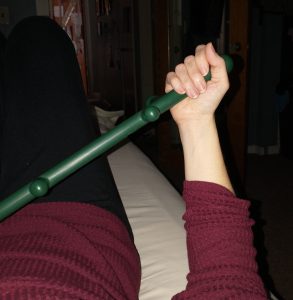
Now that the joint capsule as been tightened up my brain has not yet relearned how to interpret this joint position information from these receptors in their new, surgically-modified positions. This position where I’m lying on my back and my forearm essentially points straight up to the ceiling is considered 0 degrees of rotation.

Zero degrees rotation with cane
About 0 degrees of shoulder rotation.

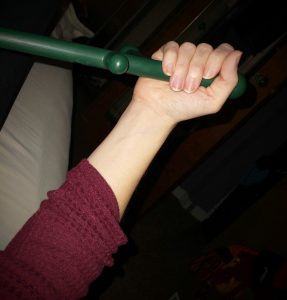
But when I close my eyes it absolutely convincingly feels like it is at at least 50 degrees of external rotation.

50 degrees of shoulder rotation.
About 50 degrees of shoulder external rotation.

But then I open my eyes and see that first 0 degree view. It’s the oddest thing.

It’s not quite as disoriented with shoulder flexion as it is with rotation. This makes sense because external rotation stretches out the anterior joint capsule more than flexion. The anterior joint capsule is the part that had to go through the most stretching out from the dislocation and subsequent tightening for the repair. Still I had my husband take this photo of me working on a table slide flexion exercise so that I could see how the joint angle is coming along because I’m not totally sure how reliable my joint position sense is for this plane of motion either.

Shoulder flexion table slide
Shoulder flexion table slide exercise.

Most of what I work on with my patients is related to this concept of proprioception. I specialize in finding ways to get the best information to a patient’s brain from their muscles and joints so that they can then have the best, most efficient output coming from the brain to the musculoskeletal system, then back and forth that conversation goes, hopefully with a higher and higher quality of information. This is giving me a close-up experience with relearning this after a significant reorganization! The neurological system is so cool.

Written by Mindy Nagel, PT, DPT, OCS · Categorized: Hypermobility, Physical therapy, Proprioception, Shoulder, Shoulder injury, Shoulder surgery

May 06 2019

Hypermobility and proprioception

Did you know you have a sixth sense? No, I’m not talking about ESP. I’m talking about proprioception. Proprioception is the sense of where you are in space. If you close your eyes and I place your right arm in a position out to your side, most people can relatively match that position with their left arm without opening their eyes to look to see exactly where I’ve placed their right arm. This sense of where you are in space helps you control your balance and posture as well. It lets you know if you are fully upright against gravity and helps you maintain yourself upright. In addition, it helps you feel your joint angles and control the alignment of your body in relation to the ground.

[Read more…] about Hypermobility and proprioception

Written by Mindy Nagel, PT, DPT, OCS · Categorized: EDS, Hypermobility, Proprioception

College Hill Pilates and Physical Therapy LLC
5838 Hamilton Ave.
Cincinnati, OH 45224

Client Portal  •  Terms and Conditions of Use

© 2026 College Hill Pilates and Physical Therapy LLC. All rights reserved.