• Skip to main content

College Hill Pilates and Physical Therapy LLC

Pilates Classes in Cincinnati

(513) 445-WELL (9355)
  • Home
  • Physical Therapy
    • Telehealth PT
  • Pilates
    • Pilates Mat Classes
    • Virtual Pilates Classes
  • Strength Training
  • Yoga
  • Tai Chi
  • Blog
  • Schedule

Physical therapy

Mar 15 2021

Experiencing a Catastrophic Shoulder Injury from a Physical Therapist’s Perspective, Part 13 — Sling-free and scapulohumeral rhythm

No more sling! NSAIDs are back!

I saw the orthopedic surgeon this morning for my 6-week follow-up appointment. The great news is he said I can stop wearing the sling! The other great news is now that I’m 6 weeks post-op I’m allowed to take ibuprofen again! NSAIDs can delay bone healing. Since all of the damage that was repaired in my shoulder was bone and cartilage I was not supposed to take any NSAIDs for 6 weeks. Tylenol really does not work for me at all. They prescribed Gabapentin and Flexeril (a muscle relaxer) immediately post-op, but both of those are hard for me to function on because they can make you sleepy and brain-foggy. So hooray for NSAIDs!

Opening for business!

I’m also opening my office for physical therapy patients and Pilates clients again. I’ve been seeing a few folks the past couple weeks as I tried to ease back in. Now that I don’t have to deal with the sling and have at least partial function of my right arm I’m welcoming back more of my people. I’m looking forward to seeing everyone again.

Scapulohumeral rhythm

I plan on posting again soon with my updated exercise routine. For now I wanted to write about what’s going on with my shoulder movement. When you raise your arm there is a certain amount of motion that comes from your scapula (shoulder blade) moving on your back and a certain amount that comes from your glenohumeral joint (the ball-and-socket shoulder joint). It varies somewhat between individuals, but generally the first 30 degrees of elevation is from the glenohumeral joint alone and the rest of the motion occurs in a 2:1 ratio of glenohumeral motion to scapular motion.

As you can see in this video, that is not what is happening right now for my right shoulder.

https://www.collegehillpilatespt.com/wp-content/uploads/2021/03/InShot_20210315_160607012.mp4

Due to the surgery, which among other things tightened up the joint capsule of my right glenohumeral joint, almost all of the motion is coming from my scapula rotating a whole lot on my back. Almost none of the motion is coming from my glenohumeral joint itself. My hypermobile scapulothoracic joint is more than up to the task of making up the difference for my hypomobile glenohumeral joint. But this is making my rhomboids and trapezius muscles on the right very cranky (painful) about having to do all this work to turn my scapula. So most of my pain (which at least now I can take ibuprofen for, yay!) is coming from those overworked and underpaid rhomboids. The surgeon says this is what he expects at this point, that it will get better with time and PT, and that I should stop worrying so much.

I’ll take another video when this is improved in the hopefully not-so-distant future to show you how it changes.

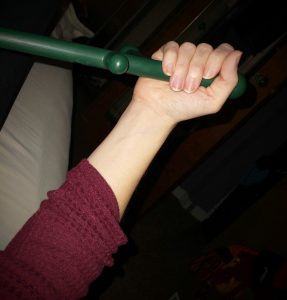
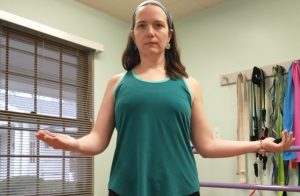
Shoulder external rotation range of motion

I also have very limited external rotation range of motion. This is my tightest direction. As you can see from this photo, it’s got a long way to go to be anywhere near like the other side. Ideally both hands should be able to open to the sides about equally. The surgeon says he expects it to eventually be within 10% of the motion of the other side, which would have no effect on function.Active Range of Motion Shoulder External Rotation
 

Incision scars are looking good

I’m including the following photo just because I thought you might like to see how well my incisions are healing up. There are 2 in the front of the shoulder and 2 in the back. I’ve been using Mederma on them, using my microcurrent point stimulators on them which are great for remodeling both external and internal scar tissue, and doing scar massage techniques on them daily. They are looking pretty good and will probably barely be visible in a year or so.
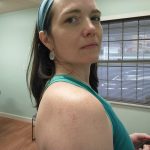

Back of shoulder incisions

Front of shoulder incisions

Written by Mindy Nagel, PT, DPT, OCS · Categorized: EDS, Hypermobility, Physical therapy, Range of motion, Scapulohumeral rhythm, Scar tissue, Shoulder, Shoulder injury, Shoulder rehab, Shoulder surgery

Mar 03 2021

Experiencing a Catastrophic Shoulder Injury from a Physical Therapist’s Perspective, Part 12 — The long, slow work of recovery

I haven’t updated the blog in a while for the simple reason that I just didn’t feel like I had anything very interesting to share. It’s been almost 7 weeks since I dislocated my shoulder and a little over 4 weeks since the surgery to repair my shoulder labrum and fill in the Hill-Sachs lesion (aka the dent left in my humerus from it being smashed into my scapula). I’ve been going to PT once a week and doing my PT exercises religiously (maybe manicly?) 3 times a day. The exercises are still mostly focused on restoring range of motion with a couple thrown in for preventing my shoulder muscles from completely atrophying. I’ll post my exercise program for you further down. I’ve met my range of motion goals for week 4. I have 2 more weeks until I’m free of the sling. All is on track. Nothing exciting to report.

I started back to work seeing a few patients and Pilates clients this week to try to ease back into normalcy. As I told a patient about not posting for a while because there’s nothing interesting to say he reminded me that the long, slow, unexciting pace of recovery is something that could actually be really important to post about. He was absolutely right! The chunks of time that seem to go on forever in between the big achievements and exciting realizations of recovery are where it gets hard. These lulls are where people tend to give up and stop doing their home exercises or drop out of physical therapy. But these are the times where perseverance is everything. You have to keep pushing on that long, slow uphill climb to get to the mountain tops where you can celebrate the bigger victories.

On the mental health front, unsurprisingly, I’ve also been pretty depressed the past couple weeks slogging through this process. Not being able to see patients/clients really brings me down. I’m thankful to be ramping my practice back up now. It’s not wasted on me how blessed I am that I have the type of job where I still get to see people face-to-face even in the midst of the pandemic.

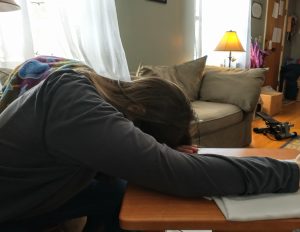
On top of that I’m still not sleeping very well. I have to sleep in the sling and still can’t sleep lying in bed so I’m using a recliner.  My shoulder gets really achey and stiff and wakes me up at about 3 or 4 am. When you don’t sleep well everything seems worse. Studies show that your pain tolerance is actually lower when you aren’t getting enough sleep. What a cruel joke! You can’t sleep because you have pain, but you can’t tolerate the pain well because you can’t sleep.

Also, if we’re going to be real here, as I’ve been walking to and from my office like I usually did daily before this injury, I’ve realized that I have a fear of walking on the sidewalk. I have to keep my eyes down on it in case one of those evil sidewalk cracks tries to grab my foot again. I keep remembering the sidewalk flying up at me and the feeling of my shoulder coming out as my hand hit the ground. Sometimes I walk in the street just to avoid being on the sidewalk (only on the empty side streets of course). I’m hoping walking regularly to and from the office, just doing it anyway, will eventually help me get over that.

And now for your excited viewing pleasure I have some photos of my current home exercise program, which I do 3 times a day without fail.

Shoulder shrugs
Various versions of shoulder shrugs, shoulder rolls, and shoulder blade squeezes. The shrugs have actually been really hard for me even though they’re usually an exercise I would give someone to start on because they’re relatively easy and innocuous. To be honest, I don’t really know why they’re so hard. I’m thinking it has to do with reduced mobility at my acromioclavicular joint.


https://www.collegehillpilatespt.com/wp-content/uploads/2021/03/20210302_1032354721.mp4

Cervical retraction to help with alignment and to counteract the effects of wearing a sling all the time.


https://www.collegehillpilatespt.com/wp-content/uploads/2021/03/InShot_20210303_002024271.mp4

Wand shoulder internal and external rotation – I’m using the dowel to let my unaffected hand and arm push my surgical shoulder into internal and external rotation. The motion you see here is all I have right now, it doesn’t go any farther in or out even though I’m pushing on it. I might not ever get full range of motion back in these directions. Studies show most people in my position don’t. But that’s okay. Since I’m not trying to be a baseball pitcher or anything I will get enough motion to be functional.


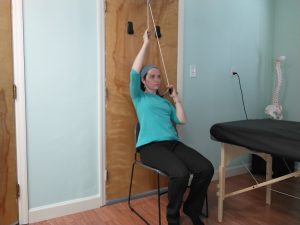
Shoulder pulleys
Shoulder pulleys allow you to pull down with your unaffected arm to stretch the surgical arm up. I’m not really allowed to go any farther up than this at the moment. My motion has to be limited and progress slowly to preserve the stiffness of the joint that the surgeon created when he tightened up my joint capsule. That way I won’t end up back where I started with a hypermobile joint.


https://www.collegehillpilatespt.com/wp-content/uploads/2021/03/InShot_20210303_003343615.mp4

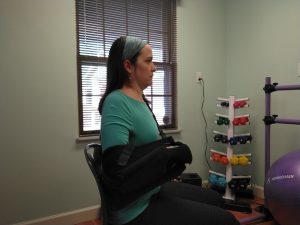
Bicep curls help keep my bicep from atrophying as much while I’m not using it as much as I would normally use it because my arm is in the sling. I’m using a 3 lb weight in this video. I’m thankful that there was no damage from the dislocation  to my bicep tendon as it comes up over my humerus. If there had been damage there I would have to avoid activation of my biceps so I wouldn’t be able to do this yet.


Rotator cuff isometrics
Rotator cuff isometrics are also to help avoid muscle atrophy. This time it’s atrophy of the rotator cuff muscles that perform shoulder external and internal rotation. My shoulder gets mad about the external rotation. I assume that’s because of the anchor through my infraspinatus muscle, which performs external rotation, into the Hill-Sachs lesion to fill it in.

In addition to all of this I’m also still using ice a few times a day and at night. I’m massaging the incisions with Mederma and using my microcurrent point stimulators, which are great at preventing and treating scar tissue, on them. I’m seeing my acupuncturist weekly, which helps a lot with pain control, anxiety, and I get my best night of sleep all week the day I see her. My rhomboids (muscles between my shoulder blade and spine) have been painful and tight so she did some cupping on them, which helped a lot. This brings me to my last point for today…

I’ve realized how lucky I am to personally know so many great health care providers. I knew a great orthopedic surgeon when I needed one, a great PT, a great acupuncturist… And I have great massage therapists and chiropractors and others that I know I can call on if (when) I’m ready and I need them. I can’t imagine going through all of this and not knowing who to see or not having that level of trust with my people. What a privilege it is for me to be the person that my patients and clients trust when they are in the midst of the long, slow climb to recovery.


Written by Mindy Nagel, PT, DPT, OCS · Categorized: Acupuncture, Hypermobility, Physical therapy, Shoulder, Shoulder injury, Shoulder rehab, Shoulder surgery

Feb 15 2021

Experiencing a Catastrophic Shoulder Injury from a Physical Therapist’s Perspective, Part 11 — Proprioception and Joint Position Sense

It’s been a week since my first physical therapy appointment, two weeks since surgery, and I’ve been working hard on my home exercises. My hardest exercises are the ones geared towards increasing my range of motion to achieve my first goal — 120 degrees of forward flexion and 20 degrees of external rotation at 4 weeks after surgery. As I’ve mentioned before, my shoulder is VERY tight. This is by design. After the dislocation my shoulder was much, much too loose. Along with the repair work he did, the surgeon tightened up the joint capsule to restore stability to the joint. So now I need to gradually work it back into a functional range of motion.

One of the weirder things about this process is how much my proprioception and joint position sense, my sense of how my arm and joint are positioned in space, is very off. Most of the receptors that send that information to our brain are located in the joint capsule.

I noticed back before surgery that I had a feeling like my insides were shaking or vibrating, like an internal tremor. This started the day of the injury and continued until I had surgery. While I haven’t found a lot of research evidence (or any) about that, my theory is that it was due to my brain being more than a little bit freaked out about the feeling of my shoulder being completely unstable and the capsule being all stretched out. That feeling stopped after I had surgery.

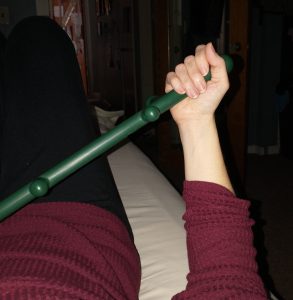
Now that the joint capsule as been tightened up my brain has not yet relearned how to interpret this joint position information from these receptors in their new, surgically-modified positions. This position where I’m lying on my back and my forearm essentially points straight up to the ceiling is considered 0 degrees of rotation.

Zero degrees rotation with cane
About 0 degrees of shoulder rotation.

But when I close my eyes it absolutely convincingly feels like it is at at least 50 degrees of external rotation.

50 degrees of shoulder rotation.
About 50 degrees of shoulder external rotation.

But then I open my eyes and see that first 0 degree view. It’s the oddest thing.

It’s not quite as disoriented with shoulder flexion as it is with rotation. This makes sense because external rotation stretches out the anterior joint capsule more than flexion. The anterior joint capsule is the part that had to go through the most stretching out from the dislocation and subsequent tightening for the repair. Still I had my husband take this photo of me working on a table slide flexion exercise so that I could see how the joint angle is coming along because I’m not totally sure how reliable my joint position sense is for this plane of motion either.

Shoulder flexion table slide
Shoulder flexion table slide exercise.

Most of what I work on with my patients is related to this concept of proprioception. I specialize in finding ways to get the best information to a patient’s brain from their muscles and joints so that they can then have the best, most efficient output coming from the brain to the musculoskeletal system, then back and forth that conversation goes, hopefully with a higher and higher quality of information. This is giving me a close-up experience with relearning this after a significant reorganization! The neurological system is so cool.

Written by Mindy Nagel, PT, DPT, OCS · Categorized: Hypermobility, Physical therapy, Proprioception, Shoulder, Shoulder injury, Shoulder surgery

Feb 11 2021

Experiencing a Catastrophic Shoulder Injury from a Physical Therapist’s Perspective, Part 10 — Tips for daily life with one functional arm

First a status report! Things are progressing very, very frustratingly slowly. I’m still struggling with pain management. I’ve used up the Percocet that I was prescribed right after surgery. I could request a refill from the doctor but given that it was only marginally effective to begin with I’m switching to acetaminophen (Tylenol). I still have gabapentin and Flexeril, but again, I’m not sure how much those are doing for me other than making me sleepy so I’m only taking them at night.  I’m pretty much using the cold therapy machine, which circulates icy cold water through a pad I strap onto my shoulder, constantly except for when I’m doing my PT homework.

Speaking of PT homework, that’s also frustrating as my motion is extremely limited. To be clear, that’s what we want because the surgeon tightened up my shoulder joint capsule so that it will be stable when all is said and done. But at the moment I can only move it maybe 2 degrees into external rotation and even that tiny motion is very painful. I also can barely shrug my shoulders up toward my ears and even that simple motion is also very painful. So very frustrating! On the other hand I finally got back to acupuncture for the first time since surgery yesterday and actually got a full night of sleep last night for the first time in 2 weeks, so I’ll take that win!

Since I dislocated my shoulder on January 14th and continuing after surgery on February 1st I have had to keep my right arm supported in a sling. Even though it’s my shoulder that’s actually hurt using my right hand is challenging too. That’s because most of the things we use our hand for require stabilization and rotation from the shoulder to get the hand in the optimal position and at the best muscular advantage to complete the task. As my patients like to point out to me, I always say everything is connected. We joke that I should get that painted on my wall so I can just point to it all day. If your shoulder can’t work correctly neither can your hand. (This is also a great illustration of how if you have a hand, wrist, or elbow problem the underlying problem might be a lack of stability and strength at the shoulder!)

Some of the things that are difficult to do with one hand are things that, before this experience, I wouldn’t have even thought about how they’d be affected. In researching how to do things with one hand many of the resources I’ve found are for people who have had amputations or were born with congenital limb differences. These modifications generally use the residual limb to assist with the activity. In the case of an injury like mine you can’t really use the injured side to help at all. So for an injury like mine the modifications are necessarily different and temporary.

I’ve found some good tips and tricks that might come in handy for anyone who, like me, is temporarily unable to use one arm for daily activities due to an injury. Of course for me it’s my dominant hand, which just complicates matters even more!

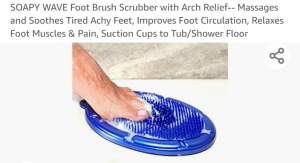
Handwashing is always essential, but especially important during a global pandemic! It’s challenging with one hand because you can’t use the friction of rubbing your hands together to soap up all surfaces of your hands. What I’ve used to solve this problem is actually meant to be used on the floor of your shower to help you wash your feet. I have it suction cupped to the side of my sink. I get some soap from a pump dispenser in my left hand and then use this to lather up my functional hand.

Foot brush used for single-hand handwashing
I’m using this foot brush scrubber for single-hand handwashing.

Dental flossing with one hand is pretty much impossible as far as I can tell with traditional floss. I’ve been using these flossers to keep up what any dentist will tell you is an essential dental hygiene habit even though I can only use my left hand. I also recommend an electric toothbrush, especially if your functional arm is your non-dominant side. That way you can make sure you are still doing a good job of brushing even though you’re using your less coordinated hand.

Flossers for single-arm dental hygiene
These are the flossers I use to keep up with flossing with one hand.

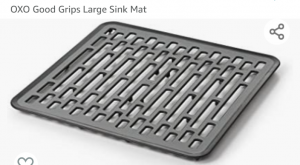
Washing dishes is difficult with one hand mostly because you normally use one hand to hold the dish in place while you scrub with the other hand. In my case, my husband has been doing most of the dishwashing. We also have a dishwasher so things that can go in there I can just rinse and put in. But sometimes I just want to wash a dish myself or I want a pan or something that can’t go in the dishwasher and I don’t want to bug my husband to do it. After all, he needs to work since one of us needs to be earning money right now! So I got this nonslip mat for the bottom of the sink to hold the dish relatively still while I scrub it with my left hand. I’ve also seen suggestions to use a hammock-like netting across the sink so that the weight of the item being washed holds it still in the fabric hammock. I figure this nonslip mat will be more useful for us in the long run as we can keep using it even after my shoulder recovers. We also have a sprayer on our sink which I’ve found essential for directing higher pressure water where I want it for rinsing.

Non-stop sink mat for washing dishes.
This is the non-slip sink mat that I got for washing dishes.

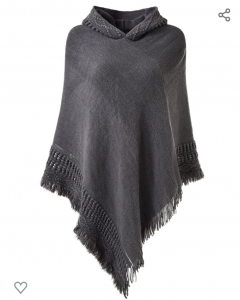
Staying warm in the middle of winter while wearing a sling is a challenge. This one is admittedly more about wearing a sling than about having one arm to use. Because of the sling I can’t just slide my right arm into a coat. I also can’t really zip up a coat by myself since that’s another thing that you have to stabilize with one hand pulling down while you pull up with the other hand. Luckily ponchos are in style right now. I even saw a hooded, faux fur-lined poncho for sale. I didn’t get that one though as it was a little beyond the price I’m willing to invest.

Hooded poncho for staying warm
This is the hooded poncho I ordered to wear when I have to go out in the cold.

Also, someone gave me this awesome thing as a gift. The Comfy is basically a giant hoody made out of a fleece-lined velour blanket. I can put The Comfy on over my head and put my left arm through the sleeve and just let the right sleeve dangle empty while my right arm stays in the sling inside it. This thing is super warm, cozy, and big enough that it’s not hard to get it over the sling.

Me in The Comfy
This is me taking a selfie in The Comfy, which is basically a giant hoody made out of a fleece-lined velour blanket. So warm and cozy!

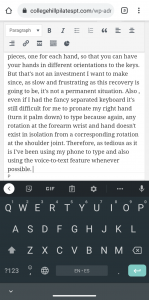
Typing on a computer has been difficult for me. This is something I wouldn’t have thought about before this injury. You would think if it’s just my shoulder affected that typing should be one of the few things that I can still do without any modification. But it’s actually difficult for me to get my right hand turned forward in the right direction to face the keyboard correctly. They do make keyboards that are separated into two pieces, one for each hand, so that you can have your hands in different orientations to the keys. But that’s not an investment I want to make since, as slow and frustrating as this recovery is going to be, it’s not a permanent situation. Also, even if I had the fancy separated keyboard it’s still difficult for me to pronate my right hand (turn it palm down) to type because again, any rotation at the forearm, wrist, and hand doesn’t exist in isolation from a corresponding rotation at the shoulder joint. Therefore, as tedious as it is, I’ve been using my phone to type and also using the voice-to-text feature whenever possible. The phone keyboard is small enough to be used with one hand or with two hands without any pronation of the right arm required.

Typing on my phone is easiest
Using my phone to type things like this or using the voice-to-text feature is much easier than trying to use a computer keyboard.

There are a lot of assistive devices out there to help with doing all kinds of activities of daily  living with one hand. Most of them are things I would only get if this was a more long-term or permanent situation or possibly if I lived alone and didn’t have a good support network of folks to help me. For example, just like with washing dishes, cooking is difficult because you would normally have one hand to stabilize the pot while you stir with the other hand. There are pot stabilizers you can get to help with that. There are also food prep boards you can get that have spikes to stabilize something while you chop it with one hand. Click here for a great resource from the UK’s NHS for all kinds of modifications to make activities of daily living easier to do with only one hand.

If you have questions or other ideas that are helpful for doing daily activities with one hand, send me a message or comment on the post on social media. You’ll find me on Facebook @chppt and on Instagram @collegehillppt.


Written by Mindy Nagel, PT, DPT, OCS · Categorized: Acupuncture, ADL Modifications, Hypermobility, Physical therapy, Shoulder, Shoulder injury, Shoulder surgery

Feb 08 2021

Experiencing a Catastrophic Shoulder Injury from a Physical Therapist’s Perspective, Part 9 — 1st PT appointment

Today was my first physical therapy appointment. I forgot to take photos so you’re stuck with diagrams of the exercises! Let’s blame it on the meds.

Many people have asked if I plan to just rehab it myself since I am a physical therapist and I normally do treat this type of injury. Sometimes it’s a good idea to treat yourself and sometimes it’s not.  It’s true that I usually do rehab my own injuries when I’ve got a muscle strain, a little tendinopathy, or when my shoulders feel a little unstable and cranky. It’s also true that I can figure out what exercises are appropriate at which stage of my recovery. But I can’t do low grade joint mobilizations on myself to help reduce pain and muscle guarding (when muscles reflexively tighten around an injured joint to protect the joint). And I’m not in a position to be able to see and measure the joint angle. My proprioception and joint position sense are TOTALLY thrown off by the injury and reconstruction. So I need another set of expert eyes to tell me where I am. And simply based on the severity of this injury, reconstruction, and rehab I need someone to walk through this with me. Even teachers need teachers. PTs sometimes need a PT.

There is thinking out there that all PT is the same and it doesn’t matter who you see. That PT is PT and all PTs are interchangeable. That couldn’t be further from the truth. As in all professions, you need to choose your PT wisely and if you start with someone that doesn’t work for you, find someone that does. So today I went back to Mt Lookout Chiropractic & Sports Injury Center, where I worked for about five and a half years before I started my current practice, to see my former coworker, Dave. He’s an excellent, experienced PT and knows me well so I feel comfortable having him help guide me through this recovery.  This is where I’d normally throw his photo in, but he’s not one for photos, or social media for that matter!

Before PT today I was feeling very discouraged. I was feeling kind of stuck, like nothing was getting better or changing. I’m still needing all the meds for pain management, although I’m only taking the muscle relaxer at night rather than 3 times a day now and I did stop taking ibuprofen. And I still can barely tolerate being out of the sling. I’m still sleeping in a recliner because it hurts to lie flat for too long. I stilñ use the cold therapy unit pretty much nonstop. And of course I’ve noticed my muscles of my right arm starting to atrophy (shrink) from disuse. My biceps looks particularly sad and floppy. As I tell my patients, everyone wants to get better yesterday.

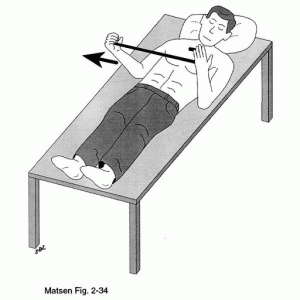
Shoulder external rotation using a cane or wand
This exercise is to begin moving the shoulder into external rotation.

At PT with Dave’s help I was able to start getting it moving. We got it to about 80 degrees of flexion (the goal at this point is 120) and got it to externally rotate a little bit. Even just doing that little bit made me feel like this isn’t forever. I know my shoulder will never be the same as it was. I don’t want it to be like it was, clearly it was too unstable! But my shoulder will be “normal” in a few months, whatever its new normal winds up being.

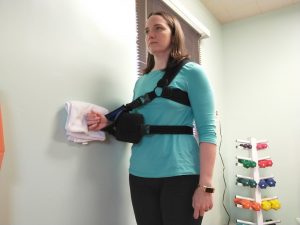
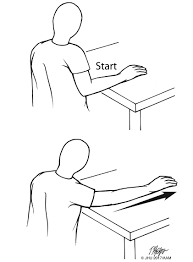
Shoulder flexion table exercise
This is the exercise I’ll be working on to improve shoulder flexion.

I’ll be working on some exercises a few times a day: shoulder shrugs and shoulder blade squeezes, elbow range of motion, table slides for shoulder flexion, using a cane for external rotation, and some pendulums using a therapy ball for support. It’s going to be hard but it gives me something to work toward. I’ll see Dave once a week for the work he can do with it that I can’t and to make sure everything is on track. As we get it moving some of the pain should start to ease too!

Stay tuned for more on my progress!


Written by Mindy Nagel, PT, DPT, OCS · Categorized: Hypermobility, Physical therapy, Shoulder, Shoulder injury, Shoulder surgery

  • « Go to Previous Page
  • Page 1
  • Page 2
College Hill Pilates and Physical Therapy LLC
5838 Hamilton Ave.
Cincinnati, OH 45224

Client Portal  •  Terms and Conditions of Use

© 2026 College Hill Pilates and Physical Therapy LLC. All rights reserved.